
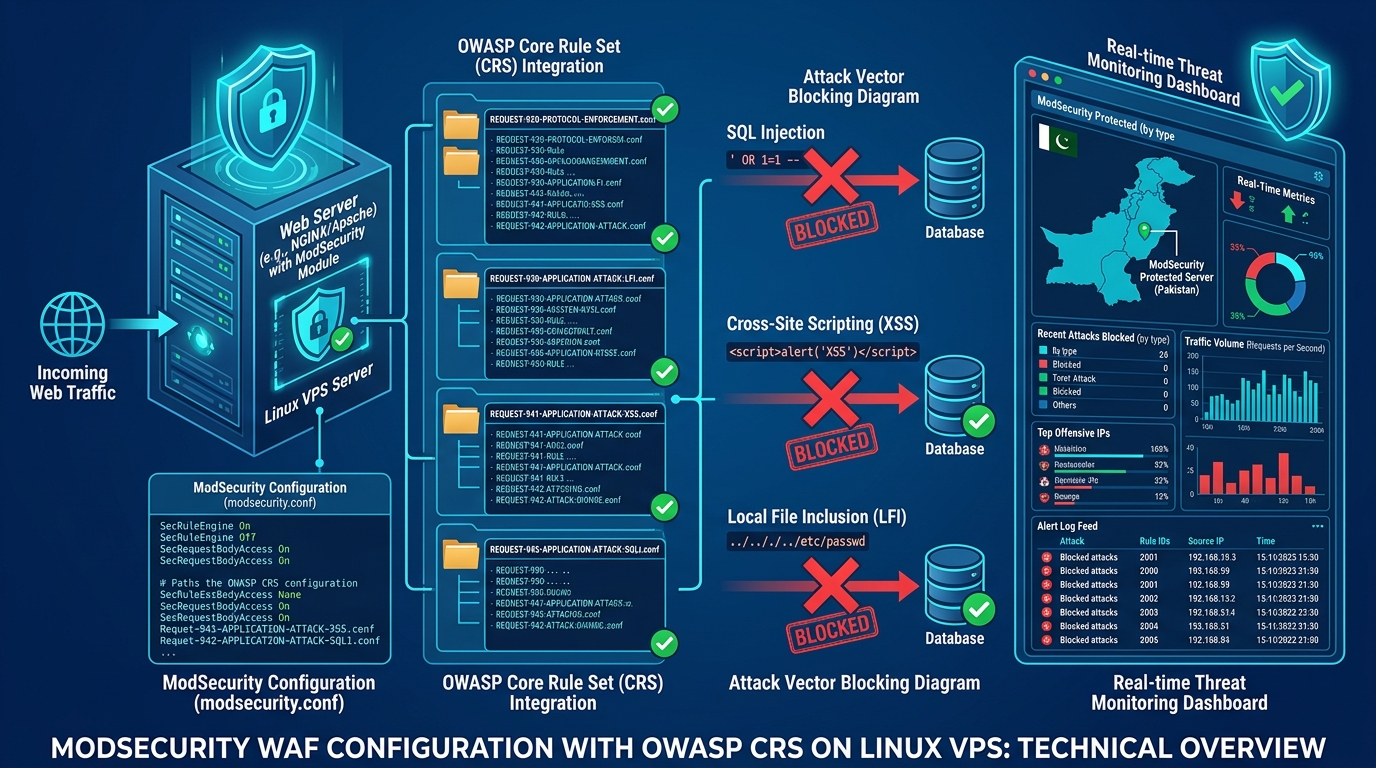
Deep-Dive Diagnostics: Resolving ModSecurity OWASP False Positives in cPanel/WordPress
When administering high-traffic WordPress sites on a cPanel/WHM server, one of the most persistent operational headaches is dealing with Web Application Firewall (WAF) false positives. ModSecurity, when paired with the OWASP Core Rule Set (CRS), is a formidable defense mechanism. However, its strict payload inspection frequently collides with the dynamic, heavily serialized, and base64-encoded payloads typical of modern WordPress page builders and plugins.
This guide provides a highly technical, deep-knowledge diagnostic approach to troubleshooting and resolving these false positives without compromising server security.
The Anatomy of a False Positive
A false positive occurs when legitimate traffic matches a signature designed to catch malicious activity. In WordPress, this often happens during:
- Saving complex posts/pages: Heavy HTML, embedded scripts, or serialized data sent via
admin-ajax.php. - Plugin/Theme updates: Payloads that resemble Remote Code Execution (RCE) or Local File Inclusion (LFI) vectors.
- REST API usage: JSON payloads containing characters or structures flagged by SQL Injection (SQLi) or Cross-Site Scripting (XSS) rules.
Disabling ModSecurity entirely is a catastrophic failure in security posture. Instead, we must employ surgical precision.
Stage 1: Granular Log Analysis
The first step is isolating the precise rule trigger. While WHM’s “ModSecurity Tools” interface is useful, true diagnostics occur at the command line.
1. Interrogating the Apache Error Log
Connect to your cPanel server via SSH as root. We need to parse the Apache error log for mod_security2 events associated with the target domain.
tail -f /usr/local/apache/logs/error_log | grep -E "ModSecurity|security2:error" | grep "targetdomain.com"To pinpoint a specific event, grep by the client IP experiencing the block:
grep "203.0.113.50" /usr/local/apache/logs/error_log | grep -i modsecurity | awk '{print $8, $9, $10, $11, $12, $13}'2. Dissecting the Audit Log Entry
A typical ModSecurity block looks like this in the error log:
[Wed Sep 02 01:15:22.123456 2026] [security2:error] [pid 12345:tid 1401234567890] [client 203.0.113.50:54321] [client 203.0.113.50] ModSecurity: Access denied with code 403 (phase 2). Pattern match "(?i:(?:\\b(?:(?:s(?:t(?:d(?:in|out|err)|d(?:out|err))|ys(?:tem|log))|c(?:o(?:mmand|n(?:f(?:ig)?|t(?:rol)?))|m(?:d|p))|e(?:x(?:ec(?:ute)?|it)|nv)|p(?:a(?:ss(?:w(?:or)?d|wd)|th)|en(?:test)?)|r(?:u(?:b(?:y|ies)|n)|e(?:v(?:erse)?|g(?:ist(?:er|ry))?))|b(?:a(?:s...\" at ARGS:content. [file "/etc/apache2/conf.d/modsec_vendor_configs/OWASP3/rules/REQUEST-932-APPLICATION-ATTACK-RCE.conf"] [line "154"] [id "932150"] [msg "Remote Command Execution: Unix Command Injection"] [data "Matched Data: cat found within ARGS:content: <p>This category is about cats.</p>"] [severity "CRITICAL"] [ver "OWASP_CRS/3.3.2"] [tag "application-multi"] [tag "language-shell"] [tag "platform-unix"] [tag "attack-rce"] [tag "paranoia-level/1"] [tag "OWASP_CRS"] [tag "capec/1000/152/248/88"] [tag "PCI/6.5.2"] [hostname "targetdomain.com"] [uri "/wp-admin/admin-ajax.php"] [unique_id "ZyXwVuTsRqPoNmLkJiHgFeDcBa"]Key Diagnostic Extraction:
- id “932150”: The exact OWASP CRS Rule ID.
- uri “/wp-admin/admin-ajax.php”: The endpoint targeted.
- ARGS:content: The specific variable (parameter) that triggered the rule.
- Matched Data: The payload (
cat) that caused the trigger. (In this case, the word “category” or “cats” falsely triggering an OS command injection rule).
Stage 2: Surgical Rule Mitigation
Once the offending rule and parameter are identified, we can create a highly targeted exclusion. Never use global rule disabling (SecRuleRemoveById 932150) if it can be avoided.
We will use ModSecurity’s SecRuleUpdateTargetById directive. This allows us to keep the rule active for the entire site, but exempt a specific parameter on a specific URI.
Implementing Custom Rules in cPanel
cPanel structures ModSecurity configurations modularly. We need to place our custom whitelist in a location where it loads after the OWASP CRS, but applies to the specific virtual host (or globally for the server, if preferred).
For a specific domain (e.g., targetdomain.com), we create an Apache userdata include:
-
Create the directory structure if it doesn’t exist:
mkdir -p /etc/apache2/conf.d/userdata/std/2_4/username/targetdomain.com/
mkdir -p /etc/apache2/conf.d/userdata/ssl/2_4/username/targetdomain.com/
(Replace
usernamewith the cPanel user). -
Create a configuration file (e.g.,
modsec_whitelist.conf) in both directories:touch /etc/apache2/conf.d/userdata/std/2_4/username/targetdomain.com/modsec_whitelist.conf touch /etc/apache2/conf.d/userdata/ssl/2_4/username/targetdomain.com/modsec_whitelist.conf -
Edit the file to add the precise mitigation:
<IfModule mod_security2.c>
  # Whitelist Rule 932150 (Unix Command Injection)
  # ONLY for the 'content' argument
  # ONLY on the /wp-admin/admin-ajax.php endpoint

  SecRule REQUEST_URI "@beginsWith /wp-admin/admin-ajax.php" \
    "id:10001,\
    phase:1,\
    pass,\
    nolog,\
    ctl:ruleRemoveTargetById=932150;ARGS:content"
</IfModule>
Explanation of the Mitigation:
SecRule REQUEST_URI "@beginsWith /wp-admin/admin-ajax.php": Limits the scope of our whitelist to the specific WordPress AJAX endpoint.id:10001: A unique ID for our custom rule (use a numbering scheme outside the OWASP range, e.g., 10000+).ctl:ruleRemoveTargetById=932150;ARGS:content: This is the crucial part. It tells ModSecurity to remove theARGS:contentvariable from the inspection list of rule932150, but only when the URI condition is met.
-
Rebuild Apache Configuration and Restart:
/scripts/rebuildhttpdconf
/scripts/restartsrv_httpd
Stage 3: Advanced Debugging with Audit Logs
If the exclusion doesn’t work, or if the payload is complex (e.g., deeply nested JSON), you need to examine the full ModSecurity Audit Log for the specific transaction.
- Take the
unique_idfrom the Apache error log (ZyXwVuTsRqPoNmLkJiHgFeDcBa). - Search the global audit log (usually
/var/log/apache2/modsec_audit.logor a specific directory structure depending on cPanel settings):grep -A 50 "ZyXwVuTsRqPoNmLkJiHgFeDcBa" /var/log/apache2/modsec_audit.log - Analyze Parts A (Header), B (Request Headers), C (Request Body), and H (Audit Log Trailer). This provides the exact raw payload the server received, allowing you to refine your targeted exclusion.
Conclusion
Managing ModSecurity in a complex WordPress environment requires shifting away from “turn it off” mentalities. By leveraging ruleRemoveTargetById and scoping exclusions to specific URIs, you maintain the robust protection of the OWASP CRS while ensuring operational stability for dynamic web applications.
For more information on optimized server environments for WordPress, check out our Managed VPS Hosting solutions.
Need Enterprise-Grade Performance?
If your workload demands maximum processing power and zero resource-sharing, explore our bare-metal Dedicated Servers and Dedicated Servers in Pakistan. We offer ultra-low latency, unmetered bandwidth, and enterprise-grade hardware to scale your operations seamlessly.